 silicone@silic0ne.com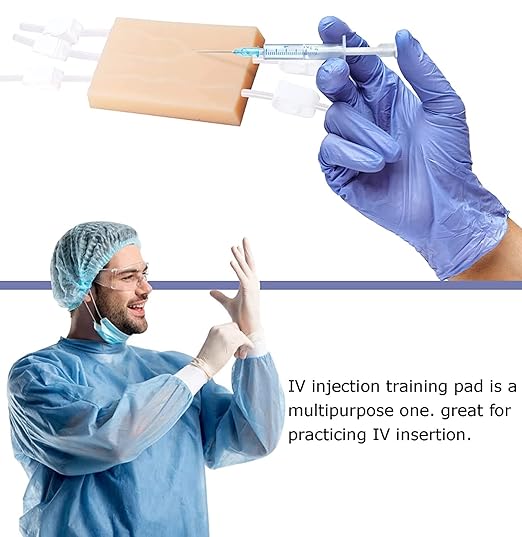

Every nurse remembers their first intravenous (IV) insertion. The trembling hands. The patient’s anxious eyes. The terrifying realization that a real human vein—unforgiving, rolling, fragile—lies just millimeters beneath real human skin. You have watched the videos. You have studied the anatomy charts. You have practiced on plastic mannequin arms with rigid, unrealistic tubing. But nothing—absolutely nothing—prepared you for the feel of a bevel penetrating a living vessel.
The stakes could not be higher. A missed IV means patient discomfort, delayed medication, and eroded confidence. A blown vein means bruising, infiltration (fluid leaking into surrounding tissue), and a second painful stick. For oncology patients receiving chemotherapy, for dehydrated children in emergency rooms, for elderly patients with fragile vessels—every attempt matters.
This is why the IV Injection Training Pad Model exists. Developed with input from clinical educators and practicing nurses, this silicone human simulated skin injection practice pad bridges the impossible gap between theory and reality. It is not a toy. It is not a simple prop. It is a sophisticated simulation tool that feels like a patient, bleeds like a patient (when set up correctly), and—most importantly—forgives like a patient never will.
In this comprehensive guide, we will explore the anatomical realism of food-grade silicone, the closed-system design using water stop clips, the portability that allows practice anywhere, and why this pad is rapidly becoming standard equipment in nursing schools, hospitals, and medical training institutions worldwide.
Chapter 1: The Crisis in Clinical Training – Why Simulation Matters More Than Ever
The medical education landscape has changed dramatically in the past decade. Patient safety initiatives, shorter hospital stays, and increased liability concerns mean that students have fewer opportunities to practice on real patients. The old model—“see one, do one, teach one”—is no longer acceptable. Today, the expectation is that students will have performed dozens, if not hundreds, of successful IV insertions on simulators before touching a living person.
However, not all simulators are equal. The typical training arm (often called a “phantom limb”) is made of rubber or vinyl. It has visible, raised “veins” that are usually too large, too firm, and too superficial. Students who train exclusively on these devices develop dangerous habits: they insert needles at the wrong angle, they fail to recognize the subtle give of a vein wall, and they cannot distinguish between arterial pulsation and venous refill.
The result? New graduates who are technically certified but clinically unprepared. A 2019 study in the Journal of Infusion Nursing found that nursing students who trained exclusively on traditional rubber mannequins had a first-attempt IV success rate of only 34% on real patients. Those who supplemented their training with high-fidelity silicone simulators improved to 78%.
The silicone IV injection training pad was designed to close this gap.
Chapter 2: Anatomy of Realism – Food-Grade Silicone and Simulated Veins
Let us examine what makes this pad different, starting with the material: high-quality, food-grade soft silicone.
Why Silicone? Unlike rubber or PVC, silicone has a durometer (hardness scale) that closely matches human skin and subcutaneous tissue. The epidermis (outer layer) is slightly firmer, providing resistance as the needle first enters. The dermis (middle layer) is softer, allowing the needle to glide. The underlying simulated fat layer gives slightly under pressure, just like a real arm or hand.
The Veins: Embedded within the silicone are flexible, hollow “veins” made of medical-grade tubing. These are not mere painted lines. They are three-dimensional structures with walls that mimic the feel of a real blood vessel. When you palpate the pad (feel with your fingertips), you can locate the vein by its characteristic bounce—firmer than the surrounding tissue but compressible. This haptic feedback is essential for proper technique.
Skin Texture: The surface of the pad features dermatoglyphics—the fine ridge patterns that form fingerprints and skin lines. While IV insertion is typically performed on the dorsal hand, antecubital fossa (inner elbow), or forearm, having realistic texture helps students practice cleaning the site, palpating for veins through skin folds, and stabilizing the skin during insertion.
Latex-Free and Non-Toxic: Because many healthcare workers and patients have latex allergies, this pad is completely latex-free. The food-grade silicone classification also means it is non-toxic, odorless, and safe for prolonged skin contact (important when instructors demonstrate techniques directly on the pad).
Chapter 3: The Closed-Loop System – Water Stop Clips and Simulated Blood Flow
Here is where the IV Injection Training Pad Model truly separates itself from cheaper alternatives. The pad comes with 5 white water stop clips, and the veins at both ends of the injection training pad feature hose connections that can be clamped to create a closed environment.
What does this mean in practice?
In a traditional training arm, you inject colored water or fake blood into an open reservoir. The fluid simply drips out or is absorbed. There is no pressure, no backflow, no sensation of “flashback” (the appearance of blood in the needle hub that confirms venous entry).
With the closed system created by the water stop clips:
- You fill the vein with simulated blood (typically red-dyed water or commercially available training fluid).
- You clamp both ends using the white water stop clips.
- The vein becomes pressurized—just like a real blood vessel under venous pressure (approximately 2-8 mmHg in peripheral veins).
- When you insert the needle correctly, you will see a flash of red fluid enter the needle hub or extension tubing. This is the same physiological feedback you would get from a patient.
- If you go through the vein (pierce the back wall), fluid will leak from the puncture site, simulating a “blown vein.”
- If you miss completely, no fluid appears—just as in real life.
This closed-loop design allows students to practice not just insertion, but also:
- Flushing the line (pushing saline to check patency)
- Drawing blood (aspirating to confirm placement)
- Troubleshooting non-functioning lines (checking for kinks, clamps, or infiltration)
The five water stop clips mean you can set up multiple practice scenarios simultaneously or replace lost clips easily. They are simple plastic clamps, but their role in creating realistic pressure dynamics is absolutely critical.
Chapter 4: Educational Applications – More Than Just IV Starts
While intravenous access is the primary use, the dermatoglyphic intravenous injection practice pad is versatile enough for multiple training scenarios:
IV Injection (Bolus): Pushing medication directly into the vein over 1-5 minutes. Students learn to assess for resistance, swelling, or patient discomfort (simulated by instructor feedback).
Infusion Training: Setting up an IV drip, adjusting flow rates, and monitoring for infiltration. The pad can be positioned at different heights to simulate gravitational flow.
Blood Transfusion: Practicing the setup of blood tubing, verifying patient identification (mock), and monitoring for transfusion reactions.
Phlebotomy (Blood Draw): Using vacuum collection tubes (Vacutainers) to draw simulated blood. The pressurized vein provides realistic resistance and flashback.
Intraosseous (IO) Access (Advanced): While the pad is designed for venous access, advanced instructors can modify it to simulate IO placement in emergency scenarios.
Who uses this pad? The manufacturer lists a wide range of institutions: social training institutions (for certified nursing assistant programs), clinics (for staff competency checks), hospitals (for new graduate orientation), medical colleges (for MD and PA students), health schools (for LPN/LVN programs), and general training centers (for EMT and paramedic skills).
Chapter 5: Portability – Training Anywhere, Anytime
One of the most underappreciated features of this injection pad is its small size and light weight.
Consider the alternative: a full-sized IV training arm is bulky, heavy (often 5-10 pounds), and requires a dedicated carrying case. You cannot fit it in a backpack. You cannot take it home easily. You certainly cannot bring it to a study group at a coffee shop.
The Gospire IV pad is approximately the size of a large mouse pad or a small notebook. It weighs less than a pound. The silicone construction is flexible enough to roll up (though not recommended for long-term storage) and durable enough to survive being tossed into a student’s backpack alongside textbooks and a laptop.
Practical benefits of portability:
- Home Practice: A nursing student can practice palpation and needle angles on their kitchen table for 15 minutes before bed.
- Peer Study Groups: Three or four students can pass the pad around during a study session, quizzing each other on anatomy and technique.
- Clinical Simulation Labs: Instructors can set up multiple stations in a small classroom without needing bulky equipment carts.
- Remote Learning: During pandemic-era distance education, schools mailed these pads to students for at-home practice, monitored via video.
- Continuing Education: Experienced nurses can use the pad to practice new techniques (like ultrasound-guided IVs) during workshops.
The pad can be easily performed or demonstrated anywhere when or as needed. In emergency medicine, where every second counts, the ability to practice the motor skills of IV access repeatedly—in any environment—builds the automaticity that saves lives.
Chapter 6: Durability and Maintenance – A Long-Term Investment
A common question from budget-conscious training programs is: “How many sticks can this pad withstand?”
The answer depends on needle gauge and technique, but with reasonable use, a single pad can endure 500 to 1,000 punctures before the silicone begins to show significant wear. Here is why:
- Self-Healing Silicone: The food-grade silicone used in this pad has elastic memory. When you withdraw the needle, the material closes around the puncture site, much like human skin (which also heals, though over days rather than seconds). Small-gauge needles (22G-25G, typical for IVs) leave almost no visible mark. Larger needles (18G for trauma situations) will leave more noticeable tracks.
- Replaceable Veins: The embedded tubing (the “veins”) can be replaced if you accidentally cut through them repeatedly. Some training programs purchase extra tubing in bulk and replace it every 100-200 sticks.
- Easy Cleaning: After each use, simply rinse the pad with warm water and mild soap. Because silicone is non-porous, it does not harbor bacteria. For deeper cleaning, use 70% isopropyl alcohol or a 10% bleach solution (followed by thorough rinsing). Do not autoclave (high-pressure steam sterilization) as high heat can degrade silicone over time.
Properly maintained, a single pad can serve an entire class of 20-30 students for an academic semester. At that point, the cost per student is negligible—far less than the cost of a single box of IV catheters used on real patients.
Chapter 7: Realistic Feedback – What Students Learn
Let us walk through a typical training session using the silicone IV injection training pad:
Step 1: Assessment
The student palpates the pad, identifying the “veins” by feel. They note the direction, depth, and bounce. They choose an appropriate site.
Step 2: Preparation
They clean the site with an alcohol swab (practicing aseptic technique). They apply a tourniquet above the site. In the closed system, the water stop clips have already pressurized the vein, simulating the engorgement caused by a tourniquet.
Step 3: Insertion
Holding the needle at a 15-30 degree angle (shallow for superficial veins, steeper for deeper ones), they advance until they feel the characteristic “pop” of entering the vein. They look for flashback.
Step 4: Confirmation
If flashback appears, they advance the catheter slightly, retract the needle, and attempt to flush with simulated saline. If they meet resistance or see swelling, they have infiltrated (the needle pierced the back wall or missed the lumen). If the flush goes easily, they have succeeded.
Step 5: Troubleshooting
Common errors produce realistic consequences:
- Too shallow: Needle does not enter the vein; no flashback.
- Too deep: Needle pierces through the back wall; flashback occurs briefly then stops; fluid leaks from the puncture site.
- Movement during insertion: Vein rolls away (simulated by the silicone’s flexibility); needle misses.
- Failure to stabilize the skin: The vein moves with the needle tip, preventing entry.
Each error provides immediate, unambiguous feedback. The student does not need an instructor to tell them they missed—the pad shows them.
Chapter 8: Comparison with Other Training Modalities
| Feature | Silicone Pad | Rubber Mannequin Arm | Live Patient (Simulated) | Virtual Reality |
|---|---|---|---|---|
| Realistic feel | Excellent | Poor | Perfect (but high stakes) | None |
| Portability | Excellent | Poor | N/A | Good (headset required) |
| Cost per use | Very low | Low | High (staff time, risk) | Moderate (hardware cost) |
| Ability to practice repeatedly | Yes | Yes | No (patient fatigue) | Yes |
| Flashback/ pressure feedback | Yes | No | Yes (but invasive) | Simulated |
| Tissue texture | High-fidelity | Low-fidelity | N/A | None |
| Self-healing | Yes (silicone) | No (permanent damage) | Yes (but unethical to puncture repeatedly) | N/A |
As the table shows, the silicone pad occupies a unique sweet spot: it offers high-fidelity haptic feedback at a low cost with excellent portability. No other training modality balances these factors so effectively.
Chapter 9: Frequently Asked Questions
Q: Do I need to buy special fluid?
A: No. Tap water with a few drops of red food coloring works perfectly. Some programs use commercially available simulated blood for a more realistic color, but it is not necessary.
Q: Can I use this for arterial line (A-line) training?
A: The pad is designed for venous access. Arteries have thicker walls, higher pressure, and pulsatile flow. While you could theoretically practice on it, the feel is not accurate for arterial line placement. Look for a dedicated arterial simulator if that is your focus.
Q: How do I store the pad?
A: Store flat at room temperature. Avoid direct sunlight (UV degrades silicone over time). Do not fold or crease for long periods. If the surface becomes tacky, dust lightly with cornstarch or talc (the same way you maintain silicone baking mats).
Q: Can left-handed students use it?
A: Yes. The pad is symmetrical. Students can approach from either side. The water stop clips can be positioned for left- or right-handed access.
Q: Is this pad compatible with all needle types?
A: Yes. It works with butterfly needles (scalp vein sets), over-the-needle catheters (IV catheters), and straight needles (phlebotomy). Needle gauges from 14G (large trauma) to 27G (insulin syringe) have been tested successfully.
Chapter 10: Hassle-Free Shopping and Customer Support
The manufacturer offers a hassle-free shopping experience with a clear promise: “If you have any questions, whether pre-sales or after-sales, you can always contact us.”
For training coordinators, this is invaluable. Perhaps you need advice on which needle gauge works best with the silicone. Perhaps one of the water stop clips arrived damaged. Perhaps you want to order replacement tubing in bulk. Perhaps you are unsure if the pad meets your specific curriculum requirements (e.g., for pediatric IV access, which requires smaller veins and shallower angles).
The customer service team is responsive and knowledgeable. Unlike generic Amazon sellers who drop-ship products they have never seen, Gospire stands behind their training tools. They understand that medical education is serious business, and they treat their customers—nursing instructors, simulation lab directors, and medical students—with the respect the profession deserves.
Conclusion: Practice Like a Professional, Save Lives Like a Pro
The silicone IV injection training pad is not glamorous. It will not win design awards. It will not appear in a medical technology conference keynote. But it will do something far more important: it will help train a generation of nurses, doctors, and paramedics who can place an IV on the first try, in the dark, under pressure, when a patient’s life depends on it.
Every healthcare professional remembers their first successful stick—the relief, the pride, the quiet confidence that said, “I can do this.” But that success should not come at the expense of a patient’s comfort. It should come after dozens of failures on a forgiving silicone pad, after hours of muscle memory training, after the freedom to make mistakes in a consequence-free environment.
The IV Injection Training Pad Model with silicone human simulated skin is that environment. It is affordable. It is portable. It is realistic. And it works.
Whether you are a nursing student preparing for your clinical rotation, a medical school faculty member building a simulation curriculum, or a hospital educator running competency checks, this pad belongs in your training arsenal.
Order yours today. Your patients—the real ones you will care for tomorrow—will never know how hard you practiced. But you will. And that makes all the difference.